Your vehicle makes a loud clunk when you shift into drive. You feel vibrations through the floor while accelerating. Or you may hear an unsettling whining noise coming from underneath your car. These symptoms could point to driveline problems, and ignoring them can lead to dangerous driving conditions and expensive repairs down the road. At Lonsdale Auto Works, Inc., we specialize in driveline repair and differential repair to keep your vehicle running smoothly and safely on Lonsdale roads.
Your driveline is the hardworking system that transfers power from your engine to your wheels, enabling your vehicle to move forward or backward. When components like the driveshaft, differential, or U-joints start wearing out, you’ll experience warning signs that shouldn’t be ignored.
Understanding what your driveline does and recognizing bad driveline symptoms early can save you time, money, and the frustration of being stranded. In this guide, we’ll explain how this critical system works, help you identify when something’s wrong, and show you why professional driveshaft repair is essential for your vehicle’s performance and your safety.
What Is a Driveline and How Does It Work?
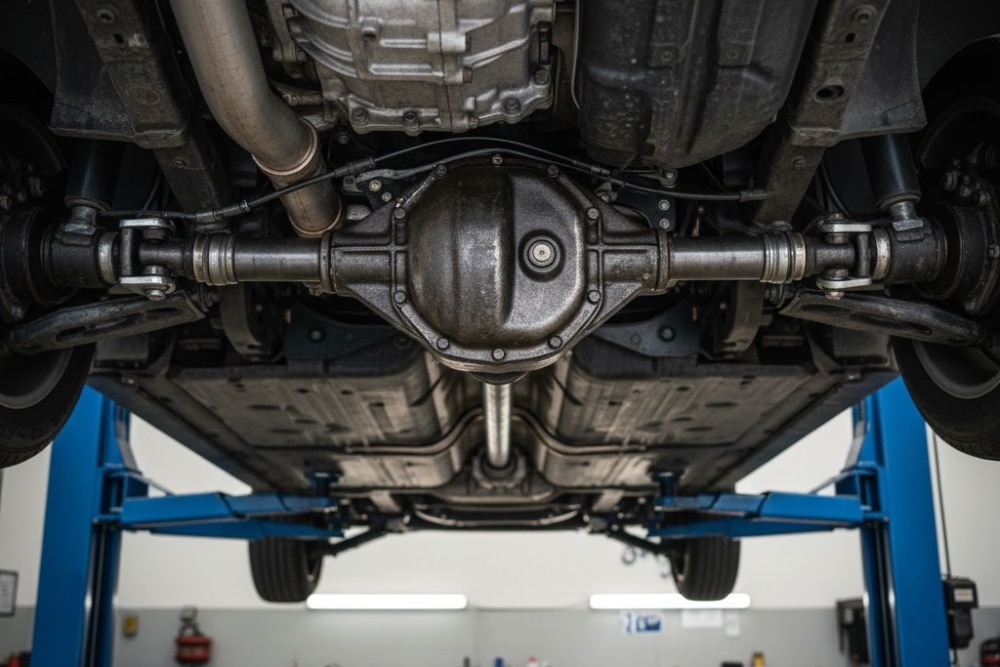
Your driveline transfers power from your engine to your wheels, allowing your vehicle to move. When you press the gas pedal, power travels through the transmission, down the driveshaft, through the differential, and finally to your wheels.
Key Components of Your Vehicle's Driveline
Your driveline consists of several critical parts that must work in harmony:
- Driveshaft: This rotating tube carries power from the transmission to the differential, using universal joints (U-joints) or constant velocity (CV) joints to handle angle changes as your suspension moves
- Differential: This gear assembly splits power between your left and right wheels while allowing them to rotate at different speeds during turns
- Axles: These shafts connect the differential to your wheels, delivering the final push of power that makes your tires rotate
- U-joints and CV Joints: These flexible connections allow the driveshaft to move with your suspension while maintaining smooth power transfer
Different vehicles use different driveline configurations. Rear-wheel-drive vehicles have a driveshaft running from front to back. Front-wheel-drive cars have a shorter setup with CV axles. All-wheel-drive and four-wheel-drive vehicles have more complex systems with transfer cases and multiple driveshafts.
Common Signs of a Bad Driveline You Shouldn't Ignore
Recognizing bad driveline symptoms early can prevent minor issues from turning into major breakdowns. Your vehicle will usually give you warning signs before complete failure occurs.
Unusual Noises Coming From Underneath Your Vehicle
Strange sounds are often the first sign of driveline trouble:
- Clunking or knocking: You might hear a heavy clunk when shifting from park to drive or drive to reverse, indicating worn U-joints or a failing differential
- Whining or howling: A high-pitched whine that changes with your speed usually points to differential problems, often due to low fluid or worn gears
- Squeaking: Rhythmic squeaking that matches your wheel speed typically means your U-joints or CV joints need lubrication or replacement
- Clicking during turns: Clicking noises when turning corners, especially in front-wheel-drive vehicles, mean your CV joints are likely failing
These noises won’t go away on their own. They typically get worse over time as damaged components continue to wear.
Vibrations or Shuddering While Driving
A healthy driveline operates smoothly without causing vibrations. If you feel unusual shaking, something is wrong:
- Vibration during acceleration: This often means your driveshaft is out of balance or your U-joints are worn
- Vibration at certain speeds: If vibrations occur at specific speeds, like 40 to 50 mph, your driveshaft might be bent or damaged
- Shuddering during turns: This symptom, especially in all-wheel-drive or four-wheel-drive vehicles, can indicate differential or transfer case problems
- Floor or seat vibrations: Strong vibrations you can feel through the floor or seats suggest a severe driveline imbalance
These vibrations indicate components spinning thousands of times per minute that are out of alignment, creating dangerous stress on other parts of your vehicle.
Difficulty Turning or Handling Problems
Your driveline affects how your vehicle handles, especially during turns:
- Resistance when turning: If your steering wheel feels stiff or your vehicle resists turning, your differential might not be splitting power correctly between your wheels
- Unusual tire wear: Driveline problems can cause your tires to wear unevenly, especially on the inside or outside edges
- Feeling like the vehicle is pulling: If your car pulls to one side during acceleration, your driveline might be delivering uneven power to your wheels
Leaking Fluids Underneath Your Vehicle
Your differential and other driveline components need special gear oil to stay lubricated. If you notice dark, thick oil puddles near the center of your vehicle or leaking grease from U-joints or CV joints, low fluid levels will lead to increased friction, heat, and rapid wear inside your differential and other driveline parts.
Get Expert Driveline Diagnostics in Lonsdale
Need help identifying strange noises or vibrations? Our ASE-certified technicians at Lonsdale Auto Works, Inc., use advanced diagnostic tools to pinpoint driveline issues quickly. Visit us at 616 Industrial Drive SE, Lonsdale, MN 55046, or call 507-744-3304 to schedule your diagnostic appointment.
Understanding the Difference Between Your Driveline and Differential
Many drivers use these terms interchangeably, but your differential is actually one component within your larger driveline system. Your driveline is the entire power delivery system from transmission to wheels, while your differential is a specific gear assembly within that system.
What Your Differential Does
When your vehicle turns, your outside wheels travel a longer distance than your inside wheels. Without a differential to allow different wheel speeds, your tires would fight each other, causing severe tire wear, poor handling, stress on your driveline system, and potential transmission damage. The differential uses a clever arrangement of gears to split engine power between your wheels while allowing them to rotate at different speeds.
How Differential Problems Affect Your Entire Driveline
Because your differential is part of your driveline, problems in one area often affect the other. A failing differential can damage your driveshaft, axles, and even your transmission. This is why comprehensive auto repair requires looking at your entire driveline system, not just individual components.
Why Professional Driveline Repair Is Essential for Your Safety
Some vehicle maintenance tasks are simple enough for DIY enthusiasts. Driveline repair is not one of them. Your driveline operates under extreme stress, spinning at high speeds while handling hundreds of horsepower. Improper repairs can lead to catastrophic failures that leave you stranded or cause accidents.
Specialized Tools and Equipment Required
Professional driveshaft repair and differential work require equipment most home mechanics don’t have:
- Dial indicators and runout gauges: These precision tools measure driveshaft balance and alignment to within thousandths of an inch
- Torque wrenches and specifications: Driveline components must be tightened to exact specifications
- Bearing pullers and presses: Removing and installing differential bearings requires specialized presses that apply even pressure without damaging precision components
- Gear pattern checking tools: Properly setting up differential gears requires checking the contact pattern between gear teeth
At Lonsdale Auto Works, Inc., we invest in advanced equipment and professional-grade diagnostic tools to ensure every repair meets manufacturer specifications.
Expert Knowledge of Different Driveline Systems
Every vehicle’s driveline is different. Front-wheel-drive systems operate differently from rear-wheel-drive configurations. All-wheel-drive and four-wheel-drive vehicles add even more complexity. Our ASE-certified technicians receive ongoing training through WORLDPAC and other professional programs to stay current with the latest vehicle technologies. We understand open differentials, limited-slip differentials, locking differentials, traditional U-joint driveshafts, CV axle systems, and vehicle-specific torque specifications.
Safety Considerations You Can't Afford to Ignore
Your driveline is a safety-critical system. A driveshaft that separates while driving can cause you to lose control. A differential that seizes can lock your wheels without warning. U-joints that fail can damage your transmission, fuel tank, or brake lines. Professional repair includes proper torque on all fasteners, correct gear oil type and fill level, balanced driveshafts, quality replacement parts, and complete system testing after repairs.
What to Expect During Professional Driveline Repair at Lonsdale Auto Works, Inc.
When you bring your vehicle to us for driveline concerns, we follow a systematic approach to ensure accurate diagnosis and complete repair.
Comprehensive Inspection and Diagnosis
We start with a thorough examination of your entire driveline system through test drives, visual inspections on our professional-grade lifts, component testing of U-joints and CV joints, differential fluid condition checks, and digital vehicle inspections. We document our findings with photos and detailed notes, which we share with you through our modern communication system.
Clear Communication About Repairs Needed
We believe in transparent communication. After our inspection, we’ll explain what’s wrong with your driveline, which repairs are urgent for safety, your options for repair, including quality levels and pricing, expected timeline for completing the work, and our 2-year/24,000-mile warranty coverage on the repairs. We never use high-pressure tactics. Instead, we have a conversation about your vehicle’s needs and your budget.
Quality Parts and Expert Installation
We use quality replacement parts designed for your specific vehicle. Whether you need a new driveshaft, U-joints, CV axles, or differential components, we source parts that meet or exceed original equipment specifications. Our technicians follow manufacturer procedures for installation, including proper torque sequences, correct gear oil types, driveshaft balancing, system alignment checks, and post-repair test drives.
Why Lonsdale Drivers Trust Us With Their Driveline Repairs
Lonsdale Auto Works, Inc. has earned a reputation as the best value in auto repair and maintenance in the area. We’re not just another repair shop. We’re your neighbors, committed to keeping our community safe and mobile.
- ASE-Certified expertise: Our technicians hold Master Technician certifications and receive ongoing training to stay current with evolving vehicle technology
- Advanced diagnostics: Our professional-grade diagnostic equipment helps us quickly identify driveline issues, from U-joint wear to carrier bearing failure
- Industry-leading warranty: Our 2-year/24,000-mile warranty coverage gives you confidence in our work
- TechNet Shop: As a TechNet member, we have access to nationwide support and resources for complex repairs
- Community commitment: Shop owner Scott Pelava serves as a Lonsdale City Councilman and is a Past President of the Lonsdale Chamber of Commerce, demonstrating our deep roots and dedication to this community
- Convenient amenities: We offer loaner cars, free Wi-Fi, and flexible drop-off options to make service convenient for your schedule
For 15 years running, we’ve won the Talk Awards for customer service excellence, and we’ve also been named Best Mechanic in 2022 and Best Tire Shop in 2023.
FAQs About Driveline Repair and Bad Driveline Symptoms
What is a driveline in a car?
A driveline is the system that transfers power from your engine to your wheels, including the driveshaft, differential, axles, and joints. Different vehicle types use different configurations, but all deliver rotational force to move your vehicle forward or backward.
What are the signs of a bad driveline?
Signs of a bad driveline include clunking noises when shifting, vibrations during acceleration, difficulty turning, and fluid leaks underneath your vehicle. These symptoms typically worsen over time and require professional inspection to prevent complete failure.
What's the difference between a driveline and a differential?
A driveline is the entire power delivery system from your transmission to your wheels, while the differential is one component within that system. The differential splits power between your wheels and allows them to rotate at different speeds during turns.
How much does driveline repair typically cost?
Driveline repair costs vary depending on the problem and vehicle type. Simple U-joint replacements cost a few hundred dollars, while differential rebuilds run into thousands. Professional diagnosis identifies what’s wrong for informed decisions.
Schedule Your Driveline Repair in Lonsdale Today
Don’t let driveline problems put you at risk or leave you stranded. If you’re experiencing clunking noises, vibrations, or any other bad driveline symptoms, our expert team is ready to help. We’ll diagnose the problem accurately, explain your options clearly, and complete repairs using quality parts and proven procedures. At Lonsdale Auto Works, Inc., we’re committed to being your best value in auto repair and service needs in the area. Visit us at 616 Industrial Drive SE, Lonsdale, MN 55046, or call 507-744-3304 to schedule your driveline inspection today. Give us a call, we do it all.